
No, Mariners Log Is Not ChatGPT for Boats
4 min read
Last week someone asked me if Mariners Log is just ChatGPT for boats. It's a reasonable question. Everyone's trying to figure out how to get value from their data right now, and ChatGPT is the obvious starting point (though I'm a Claude advocate myself).
ChatGPT and Claude are large language models. LLMs are one branch of a larger field of machine learning, which itself sits inside the broader world of AI. In simple terms, machine learning is a group of techniques for finding patterns in data. Different techniques are built for different shapes of data: numbers, images, time-series, language etc.
The popularity and capabilities of LLMs have exploded over the last few years, and they are truly awesome at doing what they do. The broader toolset of machine learning has been established for decades, quietly running aircraft engine monitoring, F1 racing optimisation, and fraud detection systems. Mariners Log is built on a toolkit designed for the specific shapes of data your vessels produce. Here's what that looks like in practice.
A hull does not fail the way an engine does. It fouls slowly over time and your first clue is usually your fuel bill.
A modern vessel produces a steady stream of data: fuel flow, engine load, RPM, exhaust temperatures, GPS position and speed. External sources have information on sea condition and weather. This information all exists. It is just not being read together in context.
A clean vessel burns a predictable amount of fuel for a given speed, load, and sea state. As the hull and propeller foul, that ratio drifts. The change is small at first, a few percent, and easy to miss voyage to voyage because the conditions are never identical. The signal is not in any single reading. It is in the gap between what the vessel should be burning and what it actually is, once you have accounted for everything else it was doing at the time.
No person could hold this in their head or read it on a graph. The variables move too fast, the trend moves too slow, and the day-to-day noise is louder than the signal underneath. A machine learning model learns what normal looks like for your vessel under any combination of conditions, and then watches for the gap between expected and actual to grow. That gap is the early signal of an issue.
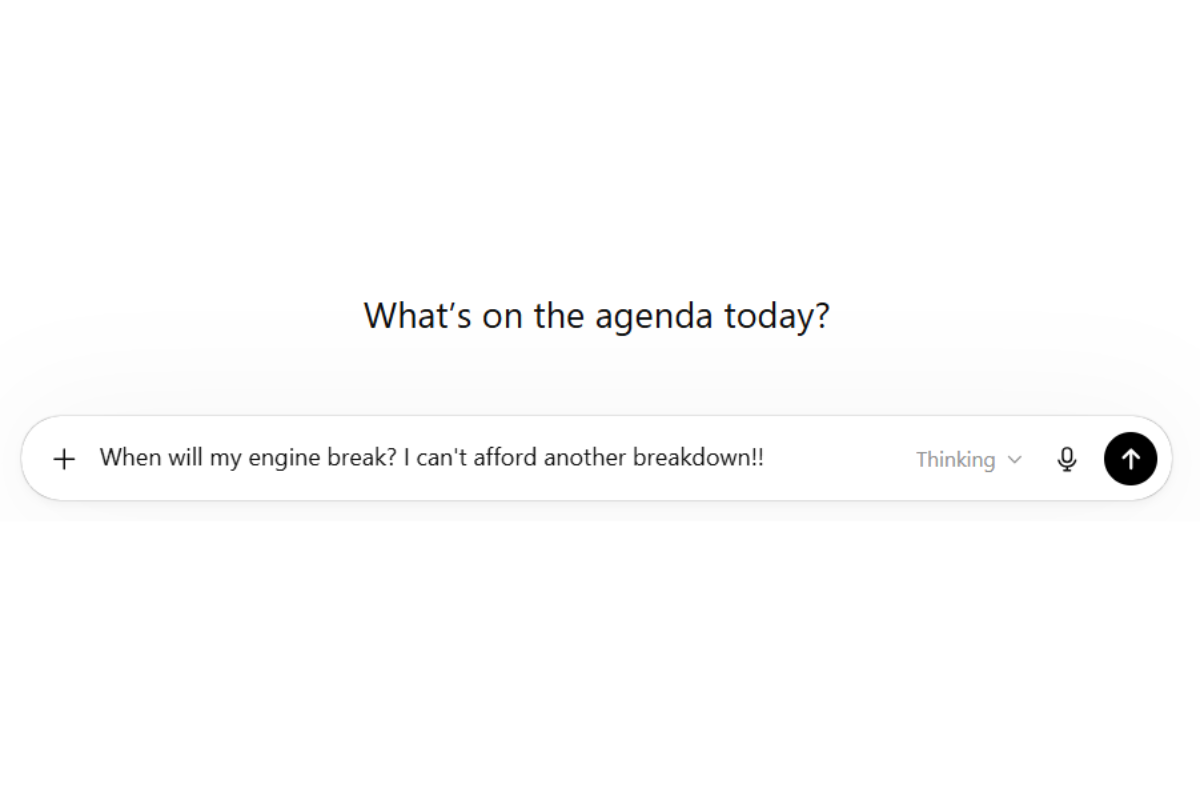
So why not just paste all of that into ChatGPT and ask?
Sensor data is numbers in time, not words. The diagnostic information lives in the precise values, in the ratios between channels, and in how those change over hours and days. Describing it in text strips most of that out. And a single vessel can produce millions of data points a day, far more than the largest language model can read in one go.
Even if you could fit the data in, an LLM produces plausible-sounding answers, not validated predictions with calibrated confidence scores. Ask it the same question twice and you may get two different answers. Ask it something it does not know and it may confidently make one up. Those are useful properties when you are drafting an email. They are the wrong properties for a system you are going to trust with the timing of a dry-dock.
This is not a problem that bigger or smarter language models will solve. A bigger dictionary does not make a translator a mathematician.
LLMs certainly have a place in building a predictive model of your vessel. Mariners Log uses them extensively for turning language data into structured data (vessel logs, work orders etc) and for turning a numerical prediction into "the hull is showing signs of fouling, recommend inspection at the next port call." When a fleet manager asks "what should I be worried about this month," an LLM is the right tool to answer in plain language, provided the predictions are already there numerically. It is not the right tool to generate those predictions in the first place. Mariners Log is built on a toolkit, not a single technique. LLMs are part of that toolkit alongside other tools designed for the specific shapes of data your vessels produce.
So, is Mariners Log just ChatGPT for boats? No. It uses your data together in context, applying the right tool for each part of the problem, so you can act on what your vessels are telling you.
Author - Nemo Miles
Mariners Log Engineering
The ultimate super yacht management system